Industrial-grade optical, solar-buoy, and handheld dissolved gas analyzers engineered for mission-critical marine and freshwater cultivation monitoring.
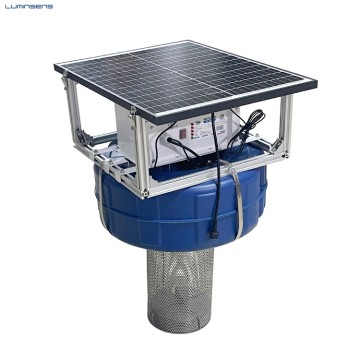
Autonomous off-grid tracking buoy equipped with solar harvesting, 4G cellular transmission, and multiparameter optical sensing probes.
Handheld optical quenching analyzer providing instantaneous dissolved oxygen and temperature telemetry with zero oxygen consumption.
Continuous-immersion optical DO sensor probe featuring RS485 Modbus-RTU protocol and anti-biofouling mechanical wipes for pond tracking.
Precision NDIR optical membrane sensor for tracking hypercapnia risks and dissolved CO₂ concentrations in intensive RAS systems.
How cutting-edge optical sensors, edge intelligence, and automated IoT telemetry are solving the multi-billion-dollar mortality and feed-efficiency challenges in global fish farming.
Sudden oxygen depletion is the primary cause of acute stock mortality in modern high-density aquaculture. Traditional electrochemical sensors suffer from polarization drift, frequent electrolyte replacement, and high membrane fouling. Next-generation smart optical DO sensors eliminate chemical drift, delivering microsecond-precision dissolved oxygen data that allows automated aerators to respond before stock stress thresholds are breached.
Feed constitutes between 50% and 70% of total operational expenditure in commercial aquaculture. Aquatic species exhibit sharp declines in appetite when dissolved oxygen falls below 5.0 mg/L or when dissolved carbon dioxide and unionized ammonia climb. Real-time smart water tracking synchronizes auto-feeders with optimal water chemistry parameters, eliminating uneaten feed waste and maximizing biological growth rates.
Modern aquaculture operations span vast marine concessions, offshore sea cages, and sprawling coastal earthen ponds where grid power and wired communication are nonexistent. Smart telemetry buoys integrating solar energy, 4G/NB-IoT cellular gateways, and edge cloud platforms enable remote farm operators to monitor hundreds of water hectares from a centralized smartphone dashboard.
Maintaining aquatic biological equilibrium requires continuous tracking of interconnected physicochemical variables. A fluctuation in water temperature directly shifts oxygen solubility, while pH shifts alter the lethal equilibrium between ammonium (NH4+) and highly toxic unionized ammonia (NH3).
Smart water sensor architectures integrate multiparameter telemetry across critical indices:
Comprehensive sensor hardware integrating 316L stainless steel, titanium optical windows, and digital industrial communications.
High-end Fluorescent DO Sensor DO200-P with 316L stainless steel core, built for high-precision water quality monitoring! Imported optical components deliver drift-free continuous telemetry.
The LMS-COD100 series water quality sensor (including LMS-COD100H and LMS-COD100L models) adopts ultraviolet absorption technology to realize real-time organic load tracking in aquaculture effluent.
The 4G module deeply collaborates with the Cloud Platform, paired with water quality sensors and analyzers to build a full-link intelligent water tracking ecosystem with remote alerting.
Designed as a field-deployable device for on-site testing in bottom sediments and aquaculture water columns, tracking toxic H₂S and CO₂ accumulation.
Portable Multi-Parameter Water Quality Analyzer integrates DO, pH, and temperature sensing in one device with dual-sensor intelligence for rapid aquaculture pond diagnostic patrols.
Antimicrobial DO Sensor LMS-DO100C with stainless steel construction, engineered for aquaculture! Biofouling-resistant fluorescent membrane ensures long-term calibration stability.
How phase-resolved luminescence detection eliminates biofouling errors and delivers continuous accuracy in bio-active water environments.
Traditional Clark-type galvanic probes rely on chemical reactions that consume dissolved oxygen at the cathode, demanding constant water stirring and suffering from rapid membrane fouling in organic-rich fish ponds. LuminSens optical sensors utilize ruthenium-complex fluorophores excited by modulated blue LED light (470nm). When oxygen molecules collide with the excited fluorophore, energy transfers non-radiatively through Stern-Volmer luminescence quenching. By measuring the phase angle shift in the emitted red light (620nm) relative to a reference red LED, the sensor determines absolute oxygen concentration without consuming a single molecule of oxygen.
Biofouling—caused by microalgae colonization, bacterial biofilms, and barnacle adhesion—is the number one failure point of in-situ aquaculture sensors. LuminSens smart sensors integrate integrated mechanical wiper blades, copper-alloy anti-biofouling guards, and hydrophobic fluoropolymer optical caps. Scheduled automated wipe cycles every 30 to 120 minutes keep the optical sensing window immaculate, extending unattended submerged deployment cycles from days to over six months without manual maintenance.
Discover how international hatcheries and commercial marine farms deploy LuminSens sensors for automated pond tracking and water treatment.
Deployment: DO + pH Sensors paired with integrated self-cleaning mechanical brushes for high-salinity Vietnamese shrimp farms. The system triggers automated paddlewheel aerators when DO drops below 4.5 mg/L, reducing shrimp stress and improving survival rates by 28%.
Deployment: Portable Dissolved Oxygen Analyzers and bottom-layer sediment tracking probes deployed across benthic sea cucumber breeding zones, ensuring precise micro-stratification DO tracking during summer thermocline inversion events.
Deployment: DO + Salinity + pH Sensors integrated with 4G Solar Telemetry Modules for Honduran coastal ponds. Farm managers receive instant SMS/App alerts during nocturnal oxygen drops, securing zero hypoxia catastrophic loss across 300+ hectares.
Deployment: UV-absorption COD + Industrial pH + Online Touchscreen Master Analyzer deployed in recirculating biofilter discharge channels, ensuring compliance with strict environmental discharge regulations.
Qingdao LuminSens Marine Technology Co., Ltd., a spin-off enterprise from the Institute of Marine Instrumentation of Shandong Academy of Sciences, is dedicated to marine monitoring technology and high-end optical water quality sensors. With a registered capital of 12.97 million yuan, we specialize in OEM R&D, production, and customization of fluorescent sensing components.
Our breakthrough innovations in dissolved oxygen, turbidity, chlorophyll, and blue-green algae sensors address critical industry challenges like leakage, slow response, and low sensitivity, delivering cost-effective solutions for aquaculture, environmental monitoring, biomedicine, and industrial applications.
Guard water resources with technology, empower sustainability with data. LuminSens aspires to lead global innovation in water quality monitoring. By advancing sensor technology and fostering partnerships, we aim to transform every drop of water into intelligent insights, building a greener future for all.
12 software copyrights & 10+ core invention patents in optical fluorescence.
Leading NSFC grants and national high-tech marine development initiatives.
Exhibited across Shanghai, Malaysia, Indonesia, Dubai with CE certification.
85% repeat purchase rate, boosting aquaculture farming efficiency by 40%.
Combining academic scientific rigour with industrial manufacturing stability.
In 2015, a team of PhD researchers in Qingdao embarked on a mission to redefine water quality monitoring. After thousands of trials, we revolutionized fluorescent sensor stability, turning lab breakthroughs into industrial-grade solutions. Today, LuminSens sensors serve as the "intelligent eyes" for rivers, lakes, and industrial waters in over 30 countries, making invisible water issues visible and actionable.
We collaborate with leading global research institutions and industry pioneers, including the Institute of Oceanology, Chinese Academy of Sciences, Chinese Academy of Fishery Sciences, and First Institute of Oceanography, Ministry of Natural Resources, while delivering customized sensor solutions for enterprises such as China National Offshore Oil Corporation (CNOOC) and China Telecom, driving innovation in marine monitoring technologies.
ISO-standard calibration laboratories, darkrooms for optical calibration, and automated environmental stress-testing facilities.


Trust fuels our journey; collaboration defines the future across marine instrumentation and environmental monitoring.


Verified operational feedback from fisheries engineers, environmental agencies, and commercial aquaculture operators.


Stringently certified under international CE, ISO9001, RoHS, and national marine technology standards.


Explore our full range of optical DO sensors, dissolved carbon dioxide analyzers, total suspended solid probes, and solar monitoring buoys.
All-in-one solar powered aquaculture buoy with integrated multiparameter monitoring and wireless cloud uplink.
Ergonomic handheld luminescent DO meter designed for quick spot-checks in ponds, hatcheries, and lab tanks.
Submersible DO probe engineered with long-life fluorophore caps and low maintenance RS485 communication.
Accurate dissolved CO₂ meter for preventing hypercapnia and monitoring degasser efficiency in recirculating systems.
Infrared light-scattering sensor for real-time suspended solids and turbidity tracking in farm biofilters and wastewater.
Dedicated continuous pond sensor featuring robust waterproof casing, rapid response time, and calibration stability.
Ultra-sensitive trace DO analyzer capable of ppb-level measurement for specialized hatchery and pharmaceutical water monitoring.
Continuous in-line immersion CO₂ probe with anti-interference membrane technology for high-density aquaculture systems.
Contact Us For Best Technical Solutions. Would you like to know more about our optical sensors, OEM customization, or IoT telemetry gateways? Leave your inquiry and our engineering team will reply within 24 hours.
Click for Inquiry